They Saved Me—Then Left Me Alone With What Had Happened
Some identifying details, including names, have been changed to protect confidentiality.
I am sitting at my desk rereading and reflecting on the pages of childhood social care records in front of me.
I am in my 40’s,
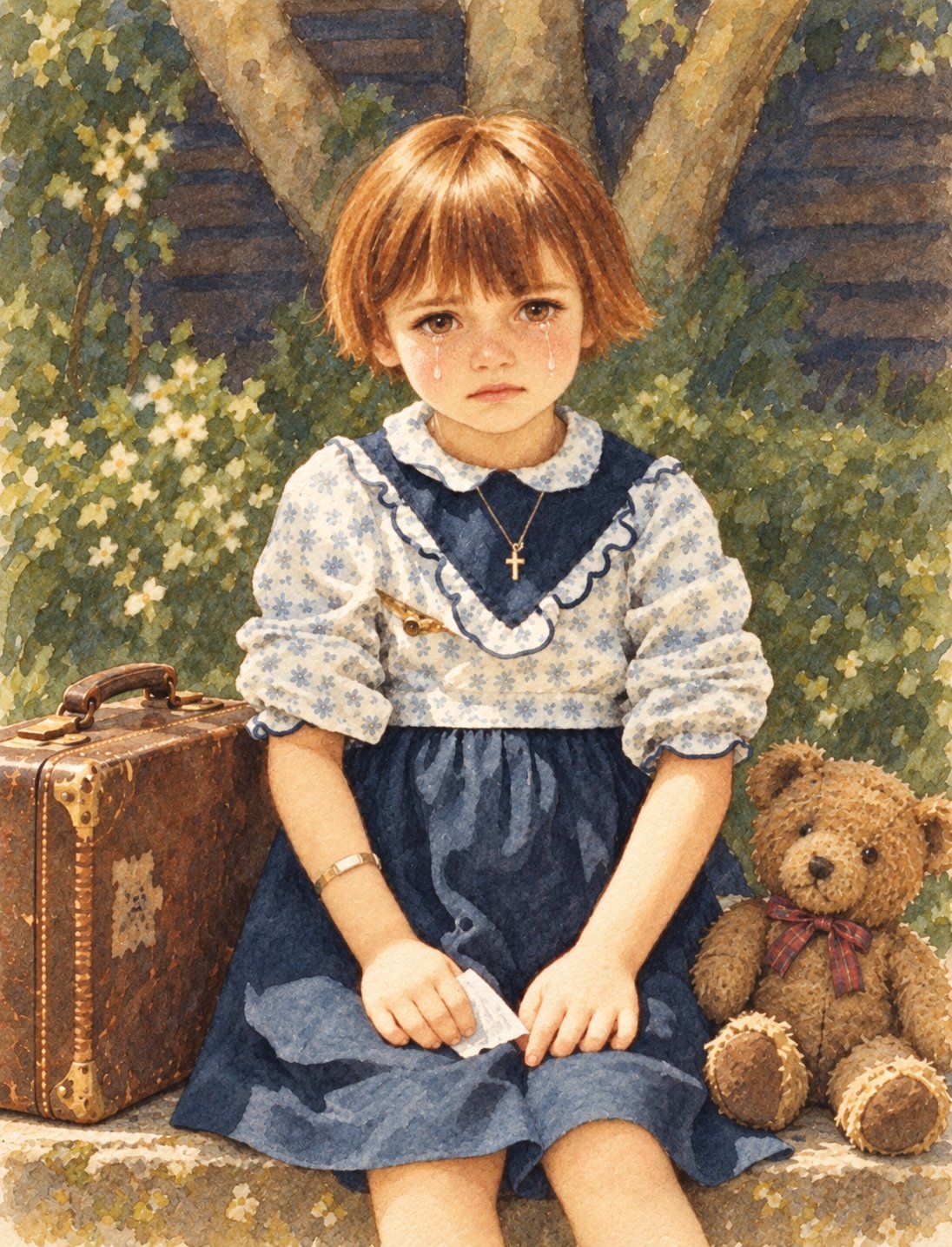
The little girl inside the file is three.
I will call her Natalie.
She is me.
I know this because we share a date of birth. I know it because the events described in these pages became the beginning of my life. I know it because I have spent decades living with feelings I could never fully explain.
But I do not remember being her.
I do not remember the rooms she slept in or the adults who came and went. I do not remember wandering unsupervised into a stranger’s home. I do not remember being hungry. I do not remember learning to fear men.
There is no clear film of it inside my mind.
There are only fragments.
A feeling of danger before I know what the danger is.
A desperate need to understand what is happening.
A fear of being in trouble.
An inability to rest until everyone else is all right.
A lifelong sense that I must be good, useful and strong.
And now there are these pages.
I begin reading.
Natalie weighed approximately 22 pounds.
I stop.
I read the sentence again.
Twenty-two pounds.
She was three years old.
She was described as pale, badly nourished, painfully thin, fragile and lifeless. A paediatrician expressed concern about the inadequacy of her diet. She struggled with ordinary meals and became exhausted very quickly.
She was terrified of being left alone. If an adult simply walked out of the room, she became desperate.
She was frightened of bathing.
She was frightened of men.
She was terrified of being beaten.
She apparently said:
“Don’t hit me. Don’t hurt me.”
When another child was smacked, Natalie became almost hysterical, seemingly convinced that she would be next.
When one of the children picked up a fishing rod, she appeared to believe it might be used to beat her.
I read these words as a counsellor and understand what they suggest.
I read them as the child they describe and feel something altogether different.
I want to reach into the page.
I want to pick her up.
I want to tell her that she is not in trouble.
I want to promise that nobody will hit her again.
But I cannot reach her.
There are more than forty years between us.
The sentence I cannot find
I keep turning the pages.
There are social workers, doctors, foster carers, solicitors, committees and officials.
There are meetings about where Natalie should live.
There are discussions about parental rights.
There are arguments about contact.
There are adults deciding who may see her, who may take her out and where she must be returned.
Everybody is talking about Natalie.
Nobody appears to be talking to her.
Her name is typed again and again. She is present in every decision, but absent as a person with an inner world.
I keep waiting for somebody to write:
“This child has experienced profound early trauma.”
I wait for the sentence:
“She will need specialist psychological support.”
I search for the referral to a clinical psychologist or child psychotherapist.
I look for the plan that will help her new family understand what neglect, fear, separation and repeated uncertainty may do to a developing child.
I keep turning the pages.
The sentence never comes.
That is when the sadness begins to change into something else.
Because they knew.
They knew she was frightened.
They knew she was undernourished.
They knew she could not bear to be left alone.
They knew she was terrified of being hit.
They knew that family contact was followed by disturbed sleep, difficulty eating, wetting, crying and clinging.
They knew her body was struggling.
They wrote it all down.
And then they moved on.
I find myself wanting to ask every professional whose name appears in that file:
You saw her.
Why did nobody help her?
Why did nobody tell her new family that providing a home was only the beginning?
Why did nobody say that safety would need to be repeated, patiently, perhaps for years, before her body could begin to trust it?
Why did nobody come back for the frightened little girl after the legal decisions had been made?
She blossomed, so they thought she was better
When Natalie entered a safer home, she changed remarkably quickly.
She began to eat.
She put on weight.
She played with the other children.
She became bright, affectionate, amusing and extremely talkative. She started nursery and appeared interested in everything around her.
A social worker compared her to a tiny seedling that had blossomed after being nurtured.
For a moment, I can see her.
A little girl discovering that meals arrive every day.
Learning that bathwater can be warm rather than frightening.
Realising that an adult can hold her without hurting her.
Finding that other children want to play rather than threaten her.
Coming alive because, perhaps for the first time, she has enough safety to do so.
It should be the happiest part of the story.
But now I wonder whether her blossoming was also what allowed everybody to stop looking.
The child was eating.
The child was smiling.
The child was beautifully dressed.
The child had become lively and manageable.
The rescue appeared to have worked.
But feeling safer is not the same as having processed what happened when you were unsafe.
Putting on weight does not erase fear.
Playing does not remove grief.
Attaching to a new caregiver does not mean that the previous separations have disappeared from the body.
A child can laugh and remain frightened.
A child can settle while still listening for footsteps leaving the room.
A child can look resilient because she has already understood that the adults are happiest when she looks all right.
Perhaps Natalie learned very early that her sadness created problems and her happiness reassured people.
Perhaps she learned to blossom because withering had not brought anybody close enough.
Her body continued to tell them
When life remained predictable, Natalie could appear happy.
But when family contact or another possible move approached, her body reacted.
She stopped sleeping.
She struggled to eat.
She became pale and tearful.
She wet herself.
She clung desperately to her foster mother.
She repeatedly needed reassurance that she would be brought back.
Before one meeting with relatives, she had reportedly been distressed for days. When the social worker arrived, Natalie was shaking and clinging, terrified that she was going to be taken away.
The social worker reassured her that she would return to her foster home.
Only then could the visit happen.
During that meeting, Natalie sat on the social worker’s lap for almost the entire time.
I cannot stop thinking about that image.
A room full of adults.
A family with their own grief, anger, longing and competing claims.
And in the middle of it, a tiny girl who cannot risk moving from the lap of the one person who has promised not to take her away.
She does not know the words attachment or developmental trauma.
She cannot explain that seeing people she loves may also awaken terror.
She cannot say:
“I want you, but I am frightened of what happens when you come.”
“I love you, but I do not know whether loving you means losing my home.”
“I do not know which mother I am allowed to need.”
“I do not know who will be hurt if I choose the wrong lap.”
She is three.
So she wets herself.
She stops eating.
She cannot sleep.
She clings.
Her body says everything.
And still, nobody makes the referral.
I am angry now
For a long time, I have tried to be fair.
I have tried to understand that it was a different time.
I have told myself that people did their best with the knowledge available to them.
I have been careful not to blame my adoptive family for what professionals may never have explained.
All of that may be true.
But something else is true too.
I am angry.
I am angry that adults could record a three-year-old saying, “Don’t hit me, don’t hurt me,” without ensuring that she received specialist psychological care.
I am angry that her dramatic improvement was treated as evidence that the problem had gone away.
I am angry that so much attention was paid to who had legal rights over her and so little to what was happening inside her.
I am angry that everybody worked to decide where Natalie belonged, but nobody appears to have helped Natalie understand belonging.
I am angry that the adults secured the placement and left the child to carry the psychological consequences.
This is not anger because I want somebody to punish.
It is the anger that arrives when grief finally understands that something essential was missing.
I was a child.
It was never my responsibility to make sense of this alone.
And then I was sent away again
Shortly after being adopted, I went to boarding school.
Perhaps it was seen as an opportunity. Perhaps it was simply what families like mine did. I cannot know exactly what the adults believed or what the child consciously understood.
But I can ask the question nobody appears to have asked:
What might boarding school mean to a child whose greatest fear was being left?
What happens when a child finally finds a family and is then asked to pack a case and sleep somewhere else?
Did Natalie understand education and opportunity?
Or did her body hear something older?
“You have found a home, but you still cannot remain in it.”
Again, she adapted.
She learned to cope.
Perhaps she learned that longing should be kept private.
That needing someone would not bring them back at night.
That appearing strong was safer than showing how much she wanted to go home.
Adults may have called that independence.
But children are sometimes called independent when they have simply learned that nobody is coming.
Where did Natalie go?
For decades, I did not know what had happened to Natalie.
But I lived with her adaptations.
She appeared whenever uncertainty became unbearable.
She appeared in the fear of being told off.
She appeared in my need to keep going, even when I was exhausted.
She appeared when another person’s withdrawal felt like catastrophe.
She appeared in the belief that I must help, perform, achieve and never let anyone down.
She appeared in the part of me that could care beautifully for everyone else but did not know how to stop.
She appeared in addiction—the desperate attempt to change what was happening inside when I had no other way to regulate it.
I cannot say that every difficulty in my adult life was caused by adoption or childhood trauma. I also have ADHD, temperament, later experiences and all the complexity of being human.
But reading these records has shown me that many of my adult struggles did not arrive from nowhere.
The woman did not invent them.
The child had reasons.
What looked like perfectionism may once have been an attempt to remain wanted.
What looked like people-pleasing may once have protected a relationship.
What looked like excessive anxiety about plans may have belonged to a child who genuinely did not know who was coming, who was leaving or where she would sleep.
What looked like relentless independence may have begun when dependence was not reliably safe.
And what looked like strength may have been a little girl holding herself together because nobody had helped her understand that she was allowed to fall apart.
I became the person they should have found for her
I am now a counsellor.
I have studied attachment, trauma, loss, regulation and the ways our earliest relationships can shape what we later expect from ourselves and other people.
I sit with adults who cannot always explain why something hurts so much.
I listen for what came before the symptom.
I notice the person who tells me something devastating and then says, “But it was fine.”
I notice the client who apologises for crying.
I notice the one who cannot stop achieving because stopping brings them too close to feelings they have spent a lifetime outrunning.
I understand now that behaviour is not simply behaviour.
Sometimes it is memory without pictures.
Sometimes it is grief without language.
Sometimes it is a child’s best attempt to preserve safety, connection and dignity.
I have spent years learning professionally what one adult should have recognised in Natalie.
There is something both extraordinary and heartbreaking about that.
I became the person they should have found for her.
I became the person who can read the file and say:
“Of course she was frightened.”
“Of course she clung.”
“Of course uncertainty still lives in her body.”
“None of this was her fault.”
But I should not have had to qualify as a counsellor to understand what happened to me.
I should not have needed a degree, specialist attachment training and years of recovery to discover that the child in those records was not difficult.
She was terrified.
Adoption cannot be the end of the care
Not every adopted person needs therapy.
Adoption is not a diagnosis, and it would be wrong to assume that every difficulty an adoptee experiences is caused by adoption.
But a child arriving with documented neglect, physical depletion, fear of adults, separation terror and repeated dysregulation should not have to become unmanageable before psychological help is offered.
A permanent home does not automatically create an internal sense of permanence.
An adoption order cannot instruct a nervous system to feel safe.
Love is essential, but love without understanding may not reach the places that learned to survive before language.
Support should follow the adopted child through the important thresholds of life: starting school, adolescence, leaving home, relationships, reunion, loss, parenthood and the eventual reading of their own records.
Adoptive families should not be left alone to interpret survival behaviour.
And adoptees should not have to wait until adulthood to discover that what looked wrong with them may once have been what kept them alive.
I am writing the missing sentence
I have searched over a hundred pages for the sentence Natalie needed an adult to write.
It is not there.
So I am writing it now.
Natalie is three years old.
She has experienced more than she can understand.
She may begin to eat, play, laugh and appear to settle. Please celebrate that—but do not mistake it for forgetting.
Her body is carrying a story for which she has no words.
She needs continuity.
She needs specialist psychological help.
She needs adults who can bear her grief without requiring her to be grateful.
She needs to know that she can love more than one family without betraying anybody.
She needs to be told what is happening before people arrive, leave or take her somewhere else.
She needs to know that her home will still be there when she wakes up.
She needs to discover that she can be angry, frightened, tired and imperfect without being sent away.
Please do not praise her for coping and then leave her to cope alone.
Please do not call her independence resilience until you have asked what made dependence feel unsafe.
Please do not wait until she is old, sitting at a desk with over a hundred pages in front of her, trying to become the witness she needed when she was three.
She is not difficult.
She is not ungrateful.
She is not asking for too much.
She is frightened.
Someone needs to go back for her.
And because nobody did, I am going now.
I am putting down the file.
I am sitting beside her.
And this time, Natalie, you will not have to make yourself good enough to be kept.
This time, somebody knows what happened.
This time, somebody believes your body.
This time, somebody stays.
anonymous